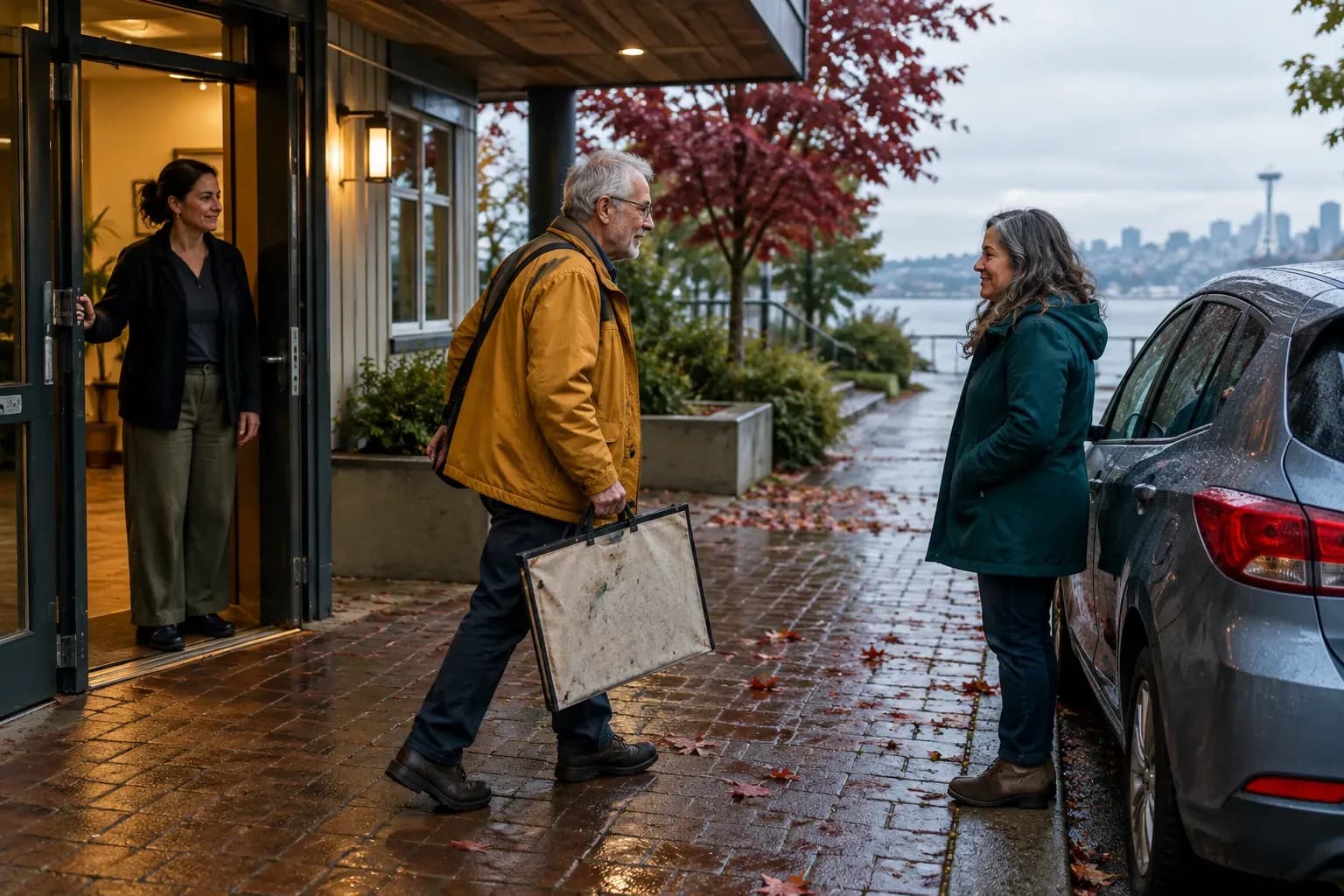
Your parent’s program starts at 10 a.m. You leave for work before eight. The afternoon session ends well before you can get home. A morning caregiver visit and another afterward might close those gaps—but only if someone also covers the rides, the waiting, and every handoff.
Before-and-after visits can work when confirmed caregivers or family members cover every period your parent or spouse cannot safely manage alone. Continuous daytime home care is more practical when transitions remain uncertain, assistance is needed throughout the gaps, or visit minimums substantially reduce the split schedule’s savings.
The question isn’t simply how many hours the program provides. It’s whether the whole day holds together. This is a scheduling framework, not a determination that someone can safely stay alone.
Start with the Seattle program’s hours—not the building’s
Elderwise’s published Seattle schedule illustrates why a day program doesn’t necessarily cover a workday:
- Memory Hub, 1021 Columbia Street: Monday–Thursday, 10 a.m.–2 p.m.
- Ravenna at Full Life Care, 6555 Ravenna Avenue NE: Thursday, 10 a.m.–2 p.m.
The University of Washington’s Memory Hub program page also lists the Memory Hub sessions as 10 a.m.–2 p.m. Those are the program hours to plan around, rather than the building’s opening hours.
Elderwise participants normally attend on the same day each week. Additional days depend on space; four published program days do not mean four available places for one participant.
Before arranging home care, reconfirm your family member’s actual attendance days, earliest staff acceptance, latest collection, closures, and procedures for transportation delays. Ask about program fit and personal-care limits, too. A schedule works only if the program can provide the support your family member needs while there.
Give every handoff a responsible person
Write the day as a sequence: family leaves → morning caregiver arrives → ride collects your parent or caregiver drives → program staff accepts them → program releases them → return trip → afternoon caregiver receives them → family returns.
At every boundary, name who is responsible and when that responsibility begins. “The ride comes around two” isn’t enough if nobody can stay until it arrives or receive your parent at home.
Look closely at any proposed time alone. Can your family member manage waiting, toileting, eating, moving around the home, and calling for help during that particular interval? Consider the morning and afternoon separately rather than assuming both are alike.
If a gap requires assistance, remove the gap from the plan. Don’t count an estimated vehicle arrival as supervision. If you’re still organizing these questions, the guide to whether a parent can still live alone can help structure the conversation; it doesn’t establish that a specific interval is safe.
Confirm transportation separately
Elderwise’s reviewed program page does not confirm transportation arrangements. Don’t book caregiver visits on the assumption that a ride is included.
Ask whether the program provides or arranges transportation, who books it, what pickup and return windows apply, whether an escort is needed, and who receives your family member at each end. If a caregiver will drive, confirm that transportation is part of the agreed assignment.
If your existing arrangement includes King County Metro Access hand-to-hand service, verify the actual service booked. Its conditions require a responsible adult at the destination, and the driver cannot enter a residence or building lobby. That ride is not indoor caregiver coverage. These conditions should not be assumed to describe every Access rider’s arrangement.
The return deserves particular attention: who stays with your parent if the vehicle arrives before the afternoon caregiver? Who remains available if it arrives late?
Test your door-to-door Seattle workday
Use your actual departure and return times on the relevant weekdays—not just your paid working hours. If you drive your parent, include the trip to the confirmed Columbia Street or Ravenna location, the handoff, and your onward commute.
SDOT’s Travelers Map provides city incidents, travel times, cameras, and bridge status. WSDOT’s real-time travel information can help you check highway portions of the route. Neither establishes a guaranteed trip time. Use those tools to build a route-specific contingency rather than applying a supposedly standard Seattle buffer.
Here’s a hypothetical comparison. Suppose family coverage ends at 7:30 a.m. and resumes at 6 p.m., and a caregiver provides transportation with program handoffs exactly at 10 a.m. and 2 p.m.:
| Arrangement | Illustrative coverage |
|---|---|
| Before-and-after visits | 7:30–10 a.m. and 2–6 p.m.: 6.5 hours total |
| Continuous home coverage instead of the program that day | 7:30 a.m.–6 p.m.: 10.5 hours total |
This is arithmetic, not a staffing offer, confirmed ride schedule, or billable-hour quote. Ask whether travel, parking, waiting, and delayed handoffs change the caregiver blocks.
Continuous home care can be an alternative for a particular day without becoming a decision to give up valued group activities altogether.
Compare the whole week, not just the hourly rate
Split visits may look economical because the program occupies the middle of the day. But ask each agency whether the morning and afternoon blocks have separate per-visit minimums. A weekly commitment is a different requirement; meeting one doesn’t necessarily satisfy the other.
Also confirm whether both blocks can be staffed, whether one or two caregivers would attend, and how cancellations, waiting, and overruns are billed. Do not assume that a short gap can be booked as an equally short visit.
For Veya’s current starting rate and weekly commitment, review Washington home-care pricing. Short gap visits may not satisfy that weekly commitment. No per-visit minimum is established by the information supplied here, so request confirmation rather than estimating one.
Compare total weekly home-care charges, program charges, and any separately arranged transportation. Include non-program weekdays and a plan for closures. Veya’s caregiver-driven transportation has no client mileage charge, but that does not mean travel or waiting time is free.
Before booking, put the fallback in writing
Gap visits are a workable option when each transition has confirmed coverage and the family member’s needs fit the arrangement. Continuous daytime coverage becomes more practical when the split plan repeatedly depends on someone leaving work, waiting without support, or improvising a handoff.
Before committing to either option, obtain written confirmation of:
- Program fit, personal-care limits, attendance days, and acceptance and collection times.
- Ride arrangements, escort needs, named handoff responsibilities, and home entry.
- Visit minimums, weekly commitments, cancellation terms, and delayed-return procedures.
- Who covers a program closure, missed ride, or unavailable caregiver.
Include your parent or spouse in the discussion about the day’s routine and the activities they value. A shorter home-care schedule is useful only if the surrounding arrangements work for them as well as for you.
You can discuss your Seattle schedule with Veya using the full door-to-door timeline rather than just the program hours. Start dates depend on finding an appropriate caregiver whose skills and availability fit the requested schedule. Neither split visits nor continuous coverage is guaranteed, so confirm the arrangement before relying on it.
Care starts at $45 per hour with a 20-hour weekly minimum. Your rate and service terms are confirmed before care begins.
This guide is general information about non-medical support at home. For diagnosis, treatment, medication, or other medical decisions, speak with a qualified healthcare professional.
Looking for support nearby? Explore caregiver placement in Seattle.