The towels are ready, but neither of you wants to start. One spouse needs help bathing; the other has been providing it and now feels uneasy about getting through the routine. Hiring someone can sound like handing over the whole morning—even when only one part has become difficult.
For couples in Sammamish, Washington, a better starting point is smaller: consider handing off the individual task that has become unwanted, difficult, or unreliable—not necessarily the entire routine. That might mean agreed-upon bathing assistance from a caregiver while you keep choosing clothes together and sharing breakfast. This is a possible arrangement, not a report of a local family's experience.
Consider a change when the older adult requests another helper, the spouse no longer feels comfortable or able to provide help reliably, or the assistance exceeds what the spouse feels able to manage safely. These are conversation prompts, not clinical thresholds. Before scheduling hands-on care, confirm both the older adult's agreement and the agency's ability to provide the exact assistance requested.
Start with what each of you wants to keep
Ask two separate questions: “What would you like help with?” and “What would you like us to keep doing together?” The answers may be different.
A spouse might want to stop helping with toileting but still enjoy brushing their partner's hair. The older adult might prefer a paid caregiver for bathing yet want their spouse nearby while getting dressed. Neither preference requires an all-or-nothing decision.
If you're an adult child helping your parents plan, make room for each parent's answer. Don't interpret one person's willingness to continue as the other's consent to receive that help. Your useful role is to record preferences, identify unresolved tasks, and help arrange a conversation with the agency—not assign intimate-care responsibilities.
Put the handoff on one page
Make a short agreement together before contacting an agency. Give each activity its own row rather than writing “morning care.”
| Activity | Steps to discuss separately |
|---|---|
| Bathing | Preparing supplies, washing, drying, and entering or leaving the bathing area |
| Dressing | Choosing clothes, putting them on, and managing fasteners |
| Toileting and incontinence support | Reaching the bathroom, adjusting clothing, toilet transfers, cleaning, and changing briefs |
| Grooming | Hair care, washing the face, and preferred grooming products |
| Eating assistance | Preparing food, setting it out, and hands-on help eating |
| Transfers | Each movement between a bed, chair, toilet, or bathing area that needs assistance |
For every row, record what the older adult does independently, the exact help wanted, and who is proposed to provide it. Add the preferred timing and sequence, privacy preferences, relevant equipment, and what should happen if help is declined.
Keep “requested” and “confirmed by the agency” separate. Your agreement is a starting point, not a guarantee that every task can be assigned to one worker.
Washington's home-care requirements call for an on-site visit and a written plan specifying services and frequency, with client or authorized-party input and approval. Bring your page into that planning conversation so the formal plan reflects the actual routine.
Bathing needs more than a single yes or no
“Help with a shower” leaves several questions unanswered. Does the older adult want someone to set out towels, wash hard-to-reach areas, help with drying, or assist with entering and leaving the bathing area? Which steps would they rather do alone?
Discuss whether the spouse should stay nearby, wait outside, or leave the room. Someone may welcome help washing but feel uncomfortable with an additional person watching.
Before booking, describe the bathroom layout and any transfer assistance needed. Ask the agency to review the space and equipment during the on-site visit. Washington's personal-care definitions recognize different levels of bathing help, but that doesn't mean every agency or caregiver can perform every step.
Veya's transfer support depends on caregiver training, the person's needs, and equipment. Agreement to provide bathing assistance should never be treated as automatic confirmation of a particular transfer.
Preserve the familiar parts of getting ready
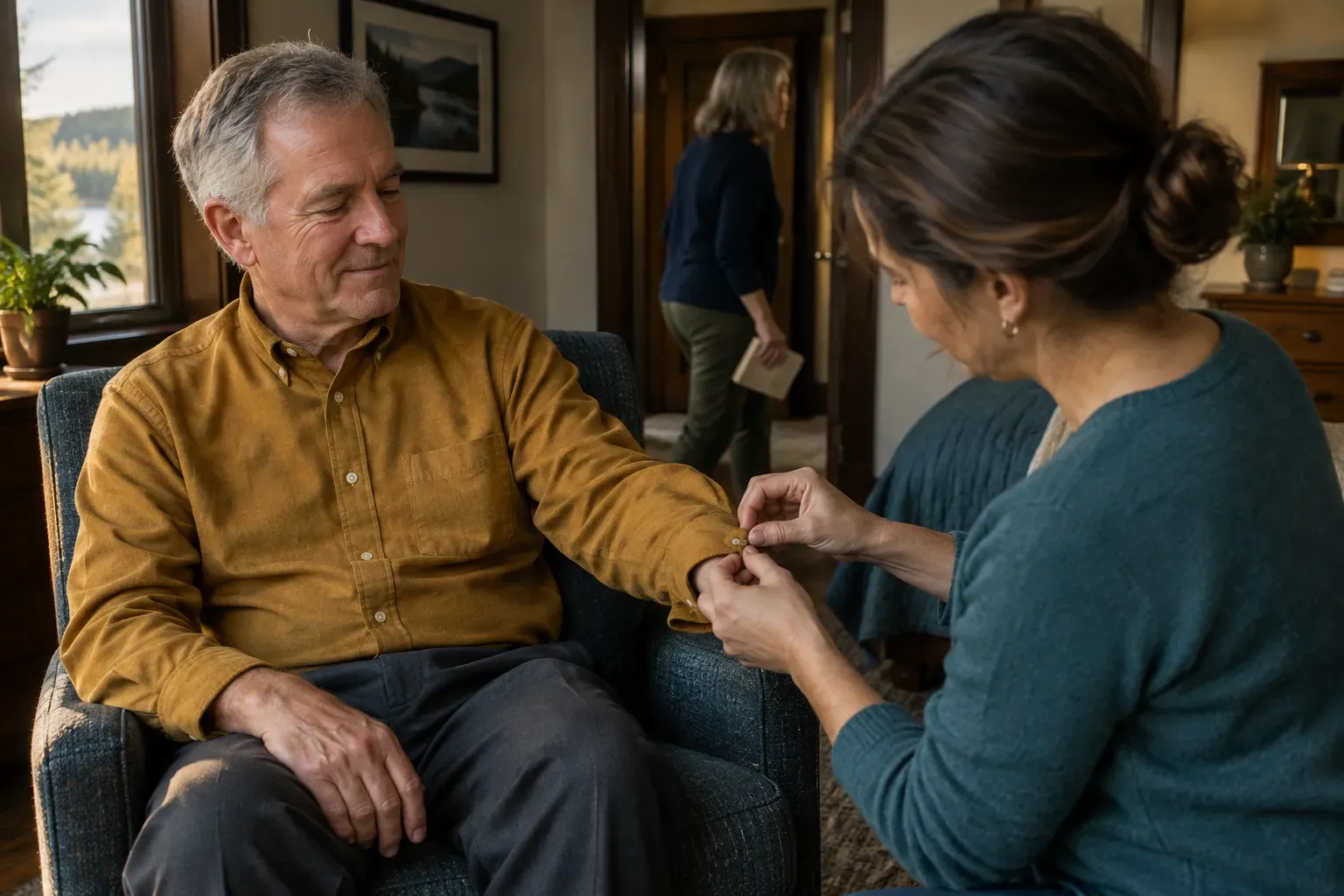
Dressing and grooming offer opportunities for a partial handoff. A proposed arrangement could leave clothing choices with the older adult, fasteners with the caregiver, and a familiar hair-care routine with the spouse—if everyone agrees.
Write down details that matter: the preferred cardigan, where grooming products belong, whether getting dressed comes before breakfast, and which steps should remain unhurried. The purpose isn't to reproduce every habit perfectly; it's to avoid replacing a familiar morning with a helper's default sequence.
Eating assistance needs the same precision. Preparing breakfast and placing a plate within reach are different from hands-on help eating. Tell the agency exactly which assistance is requested and ask it to confirm the boundaries. Don't assume that accepting one task confirms all the others.
Make toileting help discreet—and specific
Toileting can be the hardest handoff to discuss. A broad label can also hide the very step that a spouse no longer wants to provide.
Separate help reaching the bathroom from clothing adjustment, assistance on or off the toilet, cleaning afterward, and changing incontinence briefs. Washington's definitions include these forms of personal-care assistance; actual provision still requires agency confirmation.
Agree on a discreet way to request help and where supplies should be kept. Record who may be present and whether the door should be closed. Keep transfer needs on the plan rather than burying them under “bathroom help.”
A spouse can remain involved without being the person who performs every intimate step. Discuss which parts, if any, both partners want to retain.
Turn consent into an everyday practice
Consent belongs in the routine, not just on the initial paperwork. Ask that the caregiver explain what is about to happen and request permission before each intimate-care step. Agree on a simple pause signal, such as “Please stop.”
Invite the older adult to describe preferences about caregiver characteristics, while recognizing that a particular match may not be available. Record preferences without turning them into promises.
If help is refused, pause rather than force completion. The agreed response should include contacting the supervisor to discuss a revised approach. Family members shouldn't treat a booked visit as an obligation to accept every service.
Washington's home-care client rights include participation in planning, refusal of specific services, respectful treatment, privacy, and confidentiality. Make those principles concrete in your handoff agreement.
Confirm the work before confirming the schedule
Before booking, ask the agency:
- Which listed tasks can the assigned caregiver perform?
- What training and equipment are needed for each requested transfer, and can one worker meet the assessed needs?
- Who supervises care, and how do we report changed needs?
- What happens if the scheduled caregiver is unavailable?
Request written confirmation of the services, frequency, and boundaries. Veya's non-medical support services include personal-care assistance, but the particular arrangement still needs task-specific confirmation.
Check schedule fit separately. A brief bathing-only visit does not by itself meet Veya's weekly minimum. Review the current home-care pricing and scheduling terms, then ask whether wanted personal care, meal preparation, companionship, and light household support can form a suitable schedule. Don't add unwanted help simply to fill time. Start dates depend on finding a caregiver whose skills and availability fit.
Two local starting points in Sammamish
If you want independent help locating caregiver support, the City of Sammamish's Senior Human Services Coordinator can be reached at 425-295-0579. The City's senior-resource information lists local navigation and support options; don't assume those organizations provide paid intimate care.
King County's Community Living Connections line, 1-844-348-5464, offers objective, confidential information about resources and service options. Neither resource is affiliated with Veya.
Your next step can be modest: write the task agreement together, then contact Veya to discuss non-medical support and an on-site planning conversation. Once care begins, review comfort, privacy, task completion, and schedule fit with the older adult and supervisor. A useful handoff changes who provides particular help while leaving the older adult's choices—and the couple's wanted routines—intact.
Care starts at $45 per hour with a 20-hour weekly minimum. Your rate and service terms are confirmed before care begins.
This guide is general information about non-medical support at home. For diagnosis, treatment, medication, or other medical decisions, speak with a qualified healthcare professional.
Looking for support nearby? Explore caregiver placement in Sammamish.