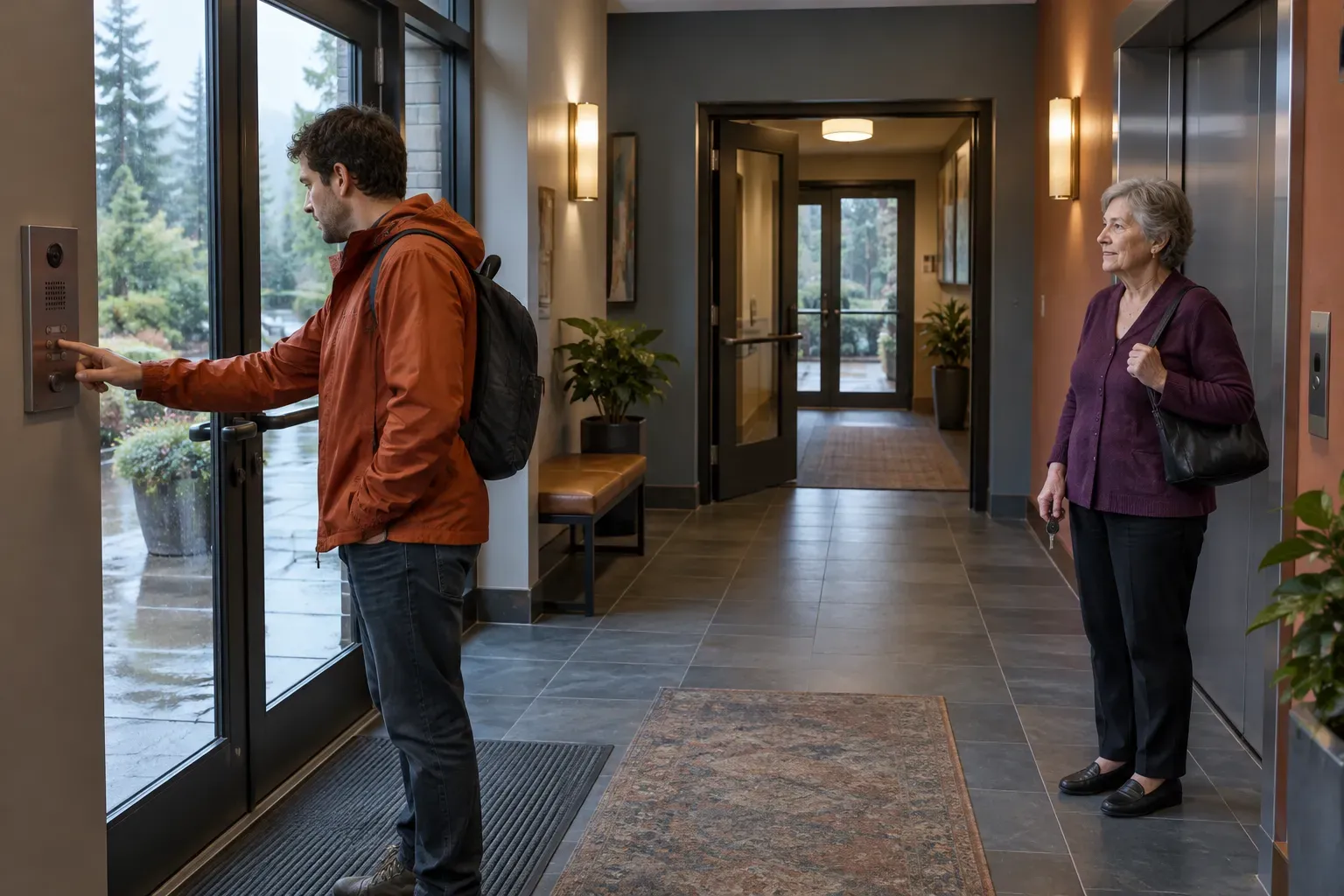
The caregiver is downstairs. Your parent is expecting someone—but the intercom hasn’t rung, your phone is on silent, and the building’s front door is locked. A carefully arranged first visit can stall before anyone reaches the apartment.
Before non-medical home care begins, answer one concrete question: Who will physically open the door at the scheduled arrival time? For an Issaquah house, that may mean your parent answering a familiar doorbell. For a condo or apartment, it may require two separate arrangements: one for the building and another for the home.
Choose one primary entry method and one workable backup. If your parent can’t reliably answer and an agency-approved independent-entry arrangement isn’t confirmed, have a named relative meet the caregiver on day one.
Choose who opens the door—not just who gets the call
The right arrangement should reflect your parent’s preferences as well as what everyone can reliably do. If you’re arranging support for your spouse, make that decision together rather than treating access as a detail to settle around them.
Your parent answers
This can be the simplest option if your parent is comfortable admitting the expected caregiver and can reach and operate the door without rushing.
Rehearse the actual arrival signal. Can they hear the doorbell from their usual chair? Does the intercom reach the right phone? Would an agreed phone call work better than knocking?
Name a backup who can actually provide access. A sibling who answers the phone from another state can help coordinate, but cannot necessarily open the door. Make clear who has the means and permission to do that.
A relative meets the caregiver
For day one, this is a practical choice when access remains unresolved. Name the relative, confirm that they’ll arrive before the caregiver, and decide what happens if they’re delayed.
A useful commitment is specific: “I’ll be inside before the visit and answer the building intercom and apartment door.” That’s stronger than “I’ll try to stop by.”
Ask your parent whether they’d like the relative to stay for introductions or leave once everyone is settled. Help with the doorway shouldn’t take away their say in the visit.
An approved key, lockbox, fob, or code
Don’t hand over a spare key or send a code until you’ve asked whether the agency accepts that method. A family’s preferred arrangement isn’t automatically an approved one.
Confirm:
- Who authorizes access and who may use it.
- How keys, fobs, codes, and alarm instructions will be shared securely.
- How access works if a replacement caregiver is assigned.
- How a key is returned or code access removed when no longer needed.
- What happens if the key, fob, or code fails.
These are questions to resolve with the agency, not promises about a particular provider’s entry practices. Until the arrangement is explicitly confirmed, keep the relative-meets-caregiver plan in place.
In an apartment or condo, test both doors
A working lobby code doesn’t necessarily get someone into the apartment. Likewise, a unit key is little help if the caregiver cannot enter the building.
Ask management or the association for current visitor-access instructions. Check the intercom listing, fob permissions, access hours, and any elevator requirements. Ask whether a caregiver’s vehicle needs registration or a visitor-parking permit.
Then write down the correct entrance, building and unit numbers, permitted parking location, and walking route. “Use the west entrance beside the mailboxes” is more useful than “Come around back,” provided it matches the property’s instructions.
Parking deserves its own confirmation. For one local example, Chopaka Apartments at 145 Newport Way NW advertises free uncovered guest parking. That is a property-specific amenity—not a citywide Issaquah rule or confirmation that a space will be available. Obtain your own property’s current rules and availability; don’t direct a caregiver to another property’s parking.
Before day one, test the route from the permitted parking area to the building entrance, then from the building entrance to the home. If the intercom works but the unit door remains locked, the test has identified an unfinished plan.
Prepare the threshold and verify the visitor
Decide which entrance the caregiver should use, even at a single-family home. Secure pets before arrival so nobody has to manage an unfamiliar dog or prevent a cat from slipping outside while making introductions. Agree on who will handle that task.
Share any necessary alarm instructions through the method agreed with the agency. Keep keys, codes, and other sensitive access details out of publicly visible arrival notes. Directions can describe the entrance without revealing how to unlock it.
Identity verification belongs in the plan, too. Ask the agency how it identifies assigned caregivers and communicates substitutions. Confirm the expected caregiver’s name before the visit.
If the person at the door differs from that information, call the agency using its previously verified number before granting entry. Don’t rely solely on a phone number supplied by the unexpected visitor. This is a recommended family safeguard, not a statement about an agency’s existing policy.
If you’re also preparing introductions, these suggestions for your first caregiver conversation can help you separate the arrival logistics from the discussion about support.
Agree on what happens if nobody answers
A no-answer plan should be written with the agency before the first visit—not improvised while someone waits outside.
Agree on a sequence such as:
- Confirm the address, building, unit, and designated entrance.
- Ring or knock and make the agreed arrival call.
- Contact the agency and designated family backup.
- Use only access that has already been authorized and approved.
Also confirm how long the caregiver should wait, how the unsuccessful arrival will be documented, and whether any visit charges could apply. Don’t assume a caregiver will wait indefinitely or try an unapproved entrance.
A routine no-answer situation and an emergency require different responses. If there is immediate danger, call 911 rather than waiting through the routine contact sequence. For a nonurgent police concern, King County lists 425-837-3200 for Issaquah/Snoqualmie. Police are not the routine entry backup or a lockout service.
Make one arrival card—and rehearse it
Keep a short arrival summary available to the people who need it, with sensitive access details stored separately through the agreed secure method. Include:
- Scheduled arrival and expected caregiver.
- Primary entry method and backup person.
- Correct entrance, parking instructions, and route to the home.
- Pet arrangements.
- Agency contact and no-answer instructions.
Run through it before the first visit. Have the designated relative try the intercom or confirm that your parent can hear the chosen arrival signal. Test both building and unit access rather than assuming one successful step proves the whole route works.
Washington requires a written home-care plan developed with client or representative input and written approval. This arrival card is a practical supplement; the rule does not specifically mandate keys, codes, or a no-answer protocol.
As you discuss non-medical support in Issaquah with Veya, bring the entry question alongside your priorities for companionship, personal assistance, or household support. Ask which access arrangements can be agreed upon before the start. The first visit should begin with a welcome—not an unresolved question at a locked door.
This guide is general information about non-medical support at home. For diagnosis, treatment, medication, or other medical decisions, speak with a qualified healthcare professional.
Looking for support nearby? Explore caregiver placement in Issaquah.