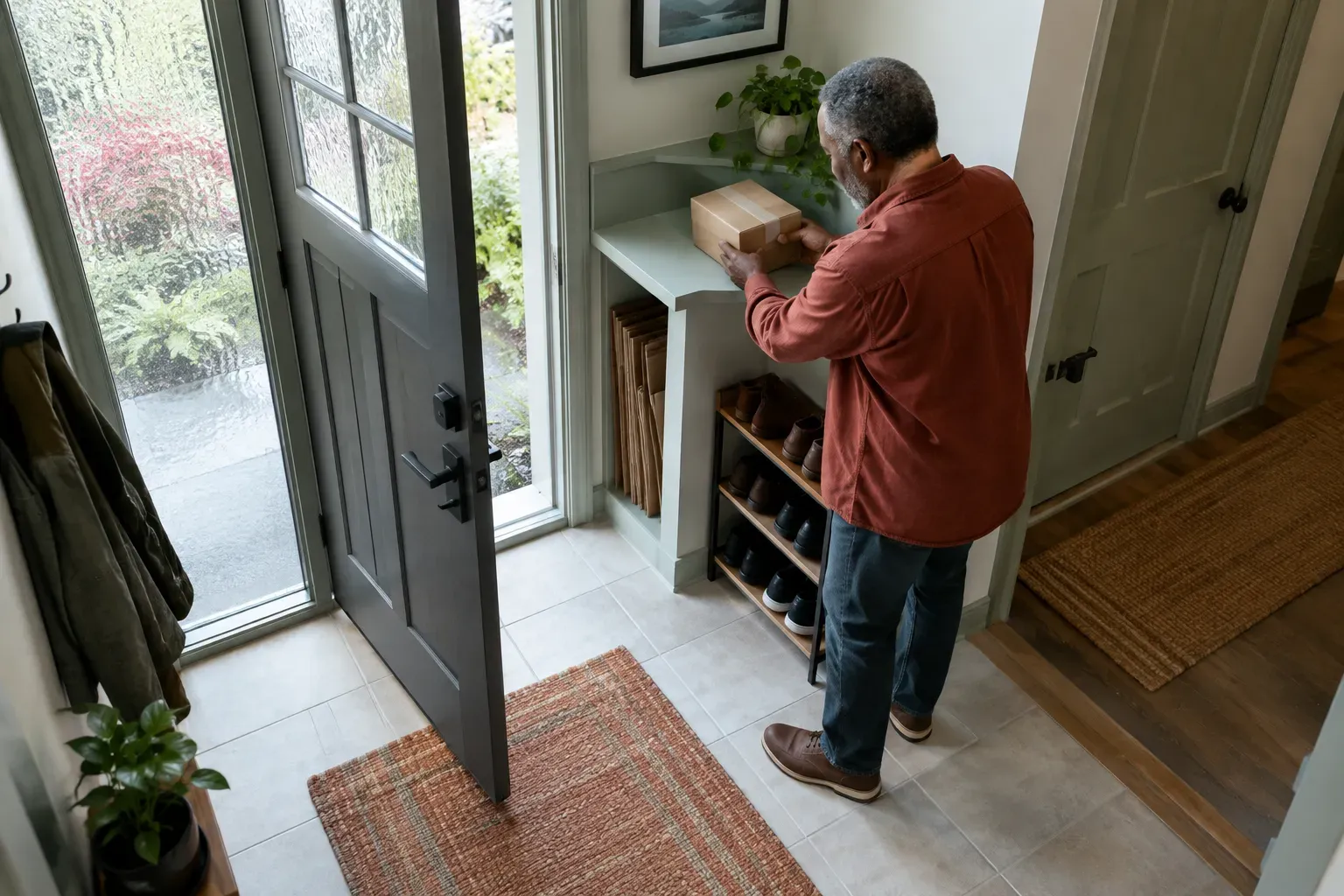
The handrail has been repaired, but the laundry basket is back on the stairs. Yesterday’s delivery boxes are beside the front door again. Nothing on the repair list explains who will move them—or where they should go.
A useful home safety checklist for seniors needs to answer two questions: What needs to change in the home, and what needs to happen repeatedly? A loose handrail needs a repair. Laundry needs a routine. Sometimes, the same spot needs both.
For families across Washington State, that distinction offers a practical way to turn a walkthrough into work that actually gets finished—without turning an older adult’s home upside down.
Sort each finding: fix, repeat, or both
Washington DSHS’s home-safety guidance includes lighting, clear walking routes, stairs, reachable storage, bathrooms, and outdoor surfaces. The Washington State Department of Health’s in-home services roadmap separately describes household work, such as cooking, cleaning, and laundry, and home maintenance, such as repairs and modifications.
Use those distinctions to organize your own list:
- Fix or modify: Repair a damaged step, address a loose handrail, or change an awkward storage arrangement.
- Repeat: Put clothes away, remove delivery packaging, or clean spills promptly.
- Both: Improve the entryway’s lighting and establish a routine for keeping shoes and parcels out of the route.
These categories are a practical family framework, not an official state scoring system. The point is to avoid treating every problem as either a construction project or a request to “keep things tidier.”
Start outside, then follow the routes used every day
Walk through the home with your parent or spouse, rather than inspecting it around them. Ask which door they use, where they carry groceries, and what route they take from the bedroom to the bathroom.
Entrance, outdoor steps, and the doorway
Look for damaged or uneven walking surfaces, obstacles, loose handrails, and lighting that doesn’t work or leaves the approach difficult to see. Include wet or icy surfaces in the conversation when conditions warrant it; Washington DSHS includes weather-related outdoor hazards in its checklist.
Separate the responses. A damaged step belongs on a repair list for an appropriate professional or property manager. Keeping parcels out of the doorway needs an agreed household routine. Outdoor surface care also needs an owner—don’t assume whoever visits next can handle it.
Check whether the door can open without pushing aside shoes, bags, or boxes. If there’s nowhere else to put them, clearing the doorway once won’t solve the underlying storage problem.
Halls, stairs, and living spaces
Follow the routes between the entrance, favorite chair, kitchen, bedroom, and bathroom. Look for:
- Furniture narrowing the route.
- Electrical cords crossing walking areas.
- Loose rugs or unsecured rug edges.
- Shoes, clothing, baskets, or other items on floors and stairs.
- Lighting that is hard to reach or doesn’t illuminate the route.
A furniture rearrangement or better cord layout may be a one-time change. Keeping the same route clear is recurring work. Discuss changes before moving a favorite chair or removing a familiar rug; the older adult should help decide what stays and what changes.
In the bedroom, check that lighting is reachable and that a phone can be kept near the bed. Include the bedroom-to-bathroom route, not just the area visible from the doorway.
Kitchen and bathroom
In the kitchen, check whether frequently used dishes, ingredients, and utensils are within easy reach. Ask which items are awkward to get—not simply which shelves look crowded. Moving everyday items to a more accessible location is a setup change; returning them there after use is a routine.
Include prompt spill cleanup and keeping floors free of bags and packaging.
In the bathroom, look for appropriate grab bars and nonskid surfaces, along with clear, dry floors. Put grab-bar installation and fixture work on the professional work list. Putting toiletries away and keeping the floor clear belong on the recurring household list. This walkthrough concerns the home environment, not personal-care techniques or medical decisions.
When the pile returns, change the process
If a basket reappears in the hall after every laundry day, ask which step is unfinished. Are clothes washed but not folded? Folded but not put away? Is the intended storage space too full?
Another general cleanup may leave the same problem waiting for next week.
For example, a household could agree to:
- Choose a basket location outside walking routes.
- Move the hamper if its current position encourages laundry to collect on the stairs.
- Assign the whole laundry sequence: washing, drying, folding, and putting away.
- Decide what happens if the usual helper cannot finish.
- Check whether the arrangement works after the next few loads.
Apply the same thinking to deliveries. Choose a parcel landing place that doesn’t obstruct doors or walking routes. Assign unpacking, putting purchases away, and removing packaging—not just bringing boxes inside.
These are suggested household workflows, not government-prescribed procedures. If the obstruction returns, revise the storage, ownership, or timing. A helper arriving before a delivery cannot unpack a box that comes later.
Match the job to the right person
Keep repair work and recurring household support on separate lists, even when they address the same space.
Repairs and modifications—such as damaged steps, loose handrails, lighting installation, and bathroom fixture work—belong with an appropriate repair or maintenance professional or property manager. Don’t treat them as ordinary caregiver tasks.
Recurring household work may include laundry, dishes, meal preparation, and putting everyday items away. Depending on the agreed service arrangement, non-medical home care may help with these tasks. Confirm the specific work with the agency rather than assuming “light household support” covers every item on your list.
For families in King and Snohomish counties, Veya provides non-medical support that includes meal preparation and light household support. If recurring tasks are the unfinished part of your plan, you can discuss which tasks may fit that support. Keep property repairs on a separate track.
Assign ownership without taking over
Begin with a question: “Which part of the house would you most like to make easier to use?” That gives your parent or spouse a say in the starting point.
Ask what they want to keep doing themselves. Someone may welcome help putting away heavy household supplies while wanting to continue folding their own clothes. Get agreement before rearranging possessions, and explain where anything moved will live.
Then give each agreed task one named owner and a backup. “The family will check the entry” is less useful than naming who checks it, when, and who steps in if that person is unavailable.
Ownership doesn’t mean one person must perform every part of the job. An adult child can own scheduling a repair while a professional completes it. The distinction makes follow-through visible.
A household safety task sheet you can copy
Use one entry per issue. This is an unscored family planning sheet, not an agency’s formal care documentation or a certification that the home is safe.
| Field | What to record |
|---|---|
| Location and issue | The exact spot and what gets in the way |
| Agreed immediate action | What the household agrees to address now |
| One-time repair or modification | The physical or storage change, if needed |
| Recurring task | The action, plus its frequency or trigger |
| Responsible person | One named owner |
| Backup | Who takes over if needed |
| Due date | When the agreed action should be completed |
| Completion status | Not started, scheduled, completed, or needs revision |
| Review date | When to check whether it worked |
For example: Hallway laundry basket. Immediate action: move it to the agreed storage spot. One-time change: relocate the hamper. Recurring task: put clothing away after each load. Add the owner’s and backup’s names, a due date, current status, and a review date next week.
A repair can be marked complete while its related routine remains active.
Revisit what actually happens
As a practical starting rhythm, check agreed walking routes during the household routine. Review the sheet after the first week of a new arrangement, then monthly while you establish what works. This timing is a suggestion, not an official requirement.
Revisit sooner if an obstruction returns, furniture or equipment changes, a helper becomes unavailable, or outdoor conditions change.
If the walkthrough raises a broader question about staying at home, you can check aging-in-place readiness in Washington. Keep this task sheet alongside that larger conversation: one helps you consider the overall picture; the other records who will repair the handrail—and who will put the laundry away.
This guide is general information about non-medical support at home. For diagnosis, treatment, medication, or other medical decisions, speak with a qualified healthcare professional.