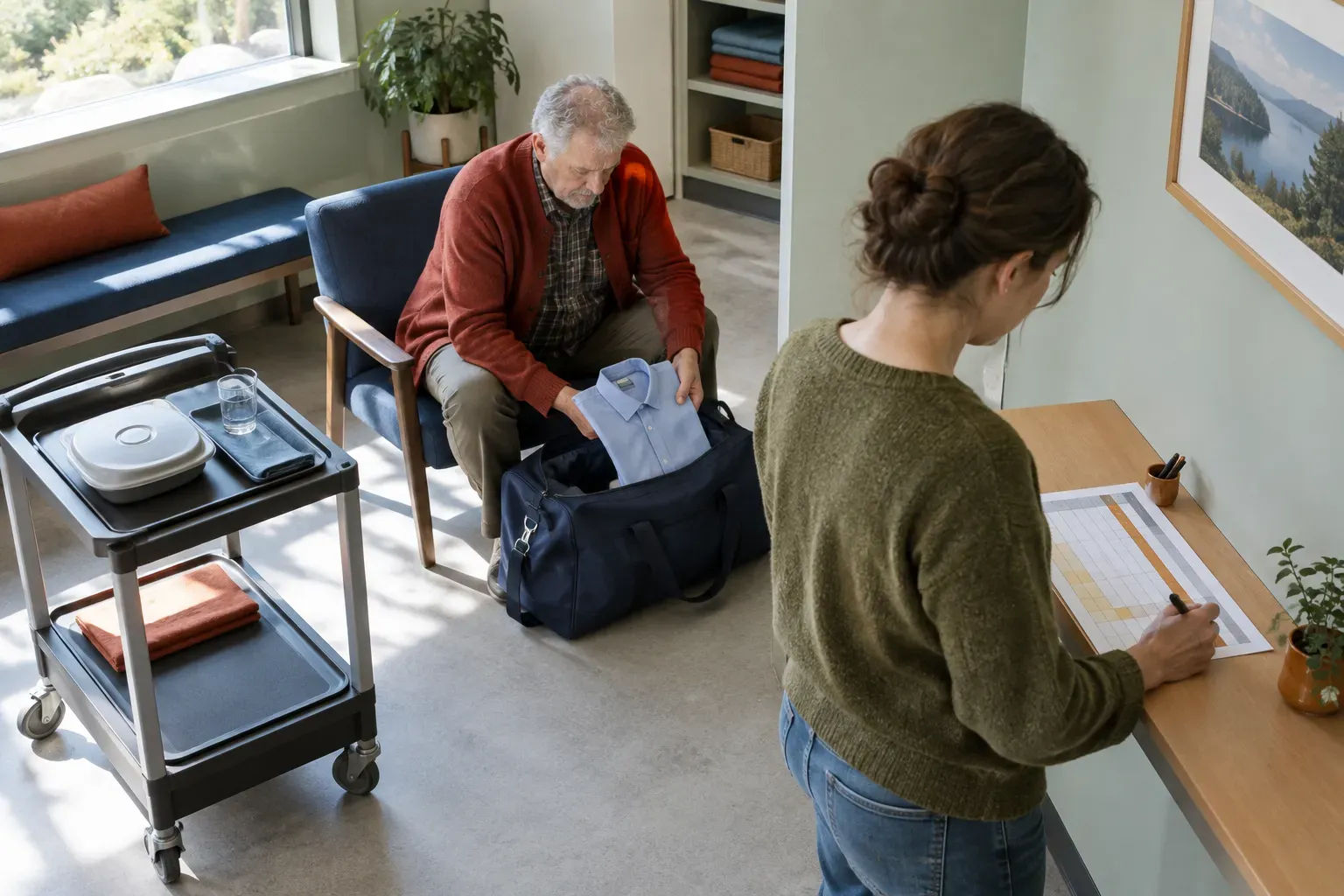
Your parent eats lunch without help at the rehabilitation facility. But someone prepares the food, brings the tray, opens the containers, and clears everything away. At home, who will do those parts?
That’s the useful starting point for choosing home care after rehab in Washington: consider paid help for necessary everyday assistance that your loved one cannot complete independently and that no willing, capable family member has explicitly agreed to provide. Leaving rehab alone doesn’t tell you which services to buy.
Build the decision task by task, including the work that happens before and afterward. The goal is a clear handoff—not a broad promise that “family will help.” This is a non-medical planning exercise, not an assessment of readiness to leave the facility or a substitute for professional guidance.
Look for the setup behind “independent”
Before assigning responsibilities at home, ask facility staff to describe what actually happens during an ordinary day. Include your parent or spouse in the conversation so their preferences and understanding are part of the plan.
Washington’s Department of Health identifies non-medical home-care services such as help with dressing, bathing, eating, toileting, personal hygiene, walking, and transfers. It also includes ordinary housework, shopping, meal preparation, and transportation to medical services. Use those categories as prompts, not as a list of services everyone needs.
For each relevant task, ask:
- Who gets the supplies ready or puts them within reach?
- Does someone remind the person to begin or help them follow through?
- Does someone stay nearby, even without touching or helping?
- What hands-on assistance is provided?
- Who cleans up, replaces supplies, or gets things ready for next time?
“Gets dressed independently” deserves a follow-up: Does that include choosing clothes, retrieving them, managing fasteners, and putting worn clothing in the hamper? “Manages lunch” might mean eating a meal that someone else has already prepared.
Record the answers in plain language: independent, setup, reminders, someone nearby, or hands-on help. These are worksheet descriptions, not official assessment scores. Don’t ask your loved one to demonstrate a task without support to prove independence; ask staff to explain the assistance currently provided and what needs clarification for home.
Build one worksheet that follows the work home
Create a shared worksheet with the columns below. The prompts are questions to resolve—not assumptions about what facility staff do or what your loved one needs.
Keep a separate row for each task or occurrence that has a different owner. Breakfast and dinner, for example, may require completely different arrangements.
| Task | Help currently supplied | Help needed at home | Timing or frequency | Older adult’s role | Named family owner and agreement | Paid-care gap | Agency confirmation |
|---|---|---|---|---|---|---|---|
| Morning dressing and grooming | Ask about setup and assistance | Record specific actions | Morning window | Record own steps | Name, days, explicit yes | Uncovered actions | Pending or accepted |
| Bathing | Ask what help is provided | Record assistance described | Agreed days and window | Record own steps | Name and explicit yes | Uncovered actions | Pending or accepted |
| Toileting and clothing changes | Ask about each part | Record assistance described | When needed | Record own steps | Name and exact agreement | Uncovered occurrences | Pending or accepted |
| Breakfast | Ask about preparation and cleanup | Record missing steps | Daily window | Record own steps | Name and days | Uncovered actions | Pending or accepted |
| Lunch | Ask about preparation and cleanup | Record missing steps | Daily window | Record own steps | Name and days | Uncovered actions | Pending or accepted |
| Dinner | Ask about preparation and cleanup | Record missing steps | Daily window | Record own steps | Name and days | Uncovered actions | Pending or accepted |
| Grocery shopping | Ask what is arranged | List purchasing and putting away | Agreed shopping day | Record participation | Name and frequency | Remaining work | Pending or accepted |
| Dishes and kitchen cleanup | Ask what follows meals | List needed actions | After which meals? | Record own steps | Name and days | Remaining work | Pending or accepted |
| Laundry and bedding | Ask what is handled | Separate washing from bed changes | Agreed frequency | Record own steps | Name and frequency | Remaining work | Pending or accepted |
| Light household tasks | Ask about relevant routines | Name each chore | Agreed frequency | Record own steps | Name and frequency | Remaining work | Pending or accepted |
| Transportation | Ask what is arranged | Specify trip and assistance | Trip windows | Record own steps | Name and trips | Uncovered trips | Pending or accepted |
| Walking or transfer assistance | Ask staff to describe current help | Record guidance and equipment | Relevant daily routines | Record own steps | Name and explicit agreement | Uncovered assistance | Confirm suitability |
Write “not needed,” “not agreed,” or “still to confirm” rather than leaving an ambiguous blank. If a responsibility remains unresolved, keep it visible instead of assigning it to whoever happens to be home.
Separate eating from getting a meal onto the plate
Consider this hypothetical example: a parent eats without assistance at rehab, but staff deliver a prepared meal and remove the tray.
At home, the daughter agrees to grocery shopping on Saturdays. The parent can independently manage an accessible breakfast. Nobody has agreed to prepare weekday lunch or wash the dishes afterward.
The proposed paid-care request is therefore weekday lunch preparation and kitchen cleanup, not automatically feeding assistance. Shopping is assigned; lunch preparation isn’t. Those are different jobs.
Before settling on a schedule, clarify whether lunch needs to be prepared during a visit or whether the parent can independently manage a meal prepared earlier. Don’t assume that having food in the refrigerator completes the task. Record any remaining steps—getting it out, opening the container, serving it, and cleaning up—and identify who owns them.
Apply the same thinking to laundry. Running the washing machine is not the same as carrying the basket, moving wet clothes, folding them, and changing the bed.
A spouse’s presence is not an agreement
Ask each family member to accept or decline specific work. Living together, being retired, or being listed as the emergency contact should not be treated as consent to take on every unassigned task.
A useful agreement sounds like this:
“I can prepare dinner on Tuesdays and Thursdays. I’m not agreeing to bathing, laundry, or overnight help.”
For a spouse, ask privately if that makes it easier to answer candidly: “Which tasks do you want to do? Which can you reliably do? Which have other people assumed you’ll handle?”
For adult children, replace “I’ll stop by” with a named responsibility and time window. Someone who can deliver groceries on Saturday has not necessarily agreed to weekday shopping, meal preparation, or putting away every delivery.
Keep willingness and ability separate. A relative may want to help but be unable to perform the particular assistance described. Leave that row unresolved until there is a workable agreement.
Turn uncovered tasks into a realistic request
Read down the paid-care gap column. Those entries become the starting point for an agency conversation.
Separate flexible chores from time-specific routines. Laundry might fit within an agreed daytime visit; help getting dressed belongs to a particular morning routine. Toileting assistance needs its own discussion rather than being absorbed into a general request for “a little help around the house.”
For every proposed visit, ask what happens after the caregiver leaves. Who owns the next meal, clothing change, or other necessary occurrence? One visit should not be assumed to cover assistance needed throughout the day.
Likewise, don’t assume an agency can provide scattered short visits simply because the worksheet identifies separate needs. Ask the agency to discuss a feasible schedule and keep any remaining gaps marked as unresolved.
Confirm the handoff on both sides
Before the move, request a task-by-task description from the facility: current assistance, setup, frequency, relevant equipment, and any instruction needed by the person accepting the task. Washington DSHS encourages planning ahead for services needed after leaving a facility and speaking with discharge planners.
UW Medicine’s hospital-discharge guidance also supports discussing available help, equipment, and caregiver instruction. That is useful transition context, not a rehab-specific assessment tool.
Then ask the home-care agency to confirm:
- Which requested tasks and levels of assistance it accepts.
- Visit days, time windows, and frequency.
- Relevant equipment and caregiver preparation.
- Tasks outside the agreement and whom to contact about an uncovered responsibility.
Washington’s home-care plan rule calls for an on-site visit, client or representative input and written approval, and identification of specific non-medical services and their frequency. Your worksheet helps prepare that conversation; it does not replace the agency’s assessment or written plan.
Use the Washington hospital-to-home care planner to organize the broader transition alongside your completed task worksheet.
For families in King and Snohomish counties, Veya can discuss its non-medical support in relation to the uncovered tasks. Start dates depend on finding an appropriate caregiver whose skills and availability fit the requested schedule.
The finished plan should make one thing easy to answer: for each necessary everyday task, who has actually agreed to do it—and when?
Care starts at $45 per hour with a 20-hour weekly minimum. Your rate and service terms are confirmed before care begins.
This guide is general information about non-medical support at home. For diagnosis, treatment, medication, or other medical decisions, speak with a qualified healthcare professional.