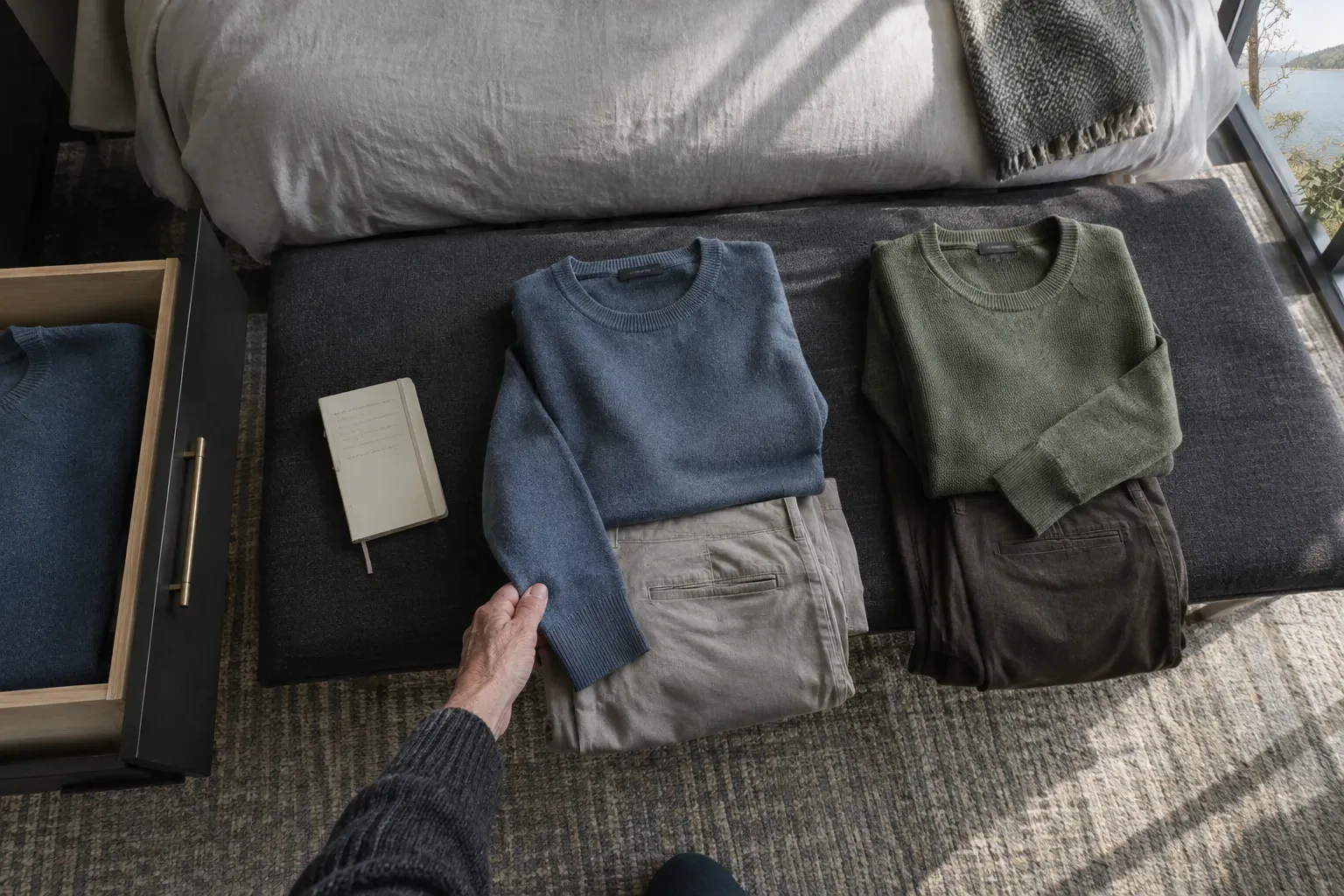
The clean shirt is ready, but your parent holds on to yesterday’s sweater. You explain that it needs washing. They say it’s fine. A second explanation gets you no closer—and now you’re both upset.
Try changing the approach rather than strengthening the argument. Offer a clean duplicate or a similar favorite, limit the choice to two items, and give one simple prompt at a time. Leave room for your parent to do the parts they can manage. If distress rises, pause instead of repeating the request.
For spouses and adult children planning support in Edmonds, Washington, the useful goal isn’t a perfectly coordinated outfit or a promise that every attempt will succeed. It’s a repeatable routine that respects comfort, privacy, and the person’s willingness to accept help.
Before asking again, check what you’re asking them to change
A favorite outfit is familiar. Its replacement may not be—even if it looks more practical to you. Before treating the situation as a disagreement about laundry, consider the clothes and the setting.
Is the room chilly? Is the television competing with your instructions? Can someone see through the doorway? Does the new shirt have an unfamiliar neckline or fastener? Your parent may also be unsure what you want them to do next.
Make the setting private and comfortable before presenting another request. Ask whether they want the door closed and who they’re comfortable having nearby. Don’t assume that accepting help from a spouse means they’ll accept the same help from an adult child or a new caregiver.
Keep preferred styles and fabrics whenever possible. A soft, familiar pullover may be a better starting point than an entirely new wardrobe selected for convenience. Clean duplicates or similar versions of a favorite outfit are worth trying, though they don’t guarantee acceptance.
Separate your preferences from the practical task, too. If your parent chooses an unusual color combination, consider whether that really needs correcting. The aim is comfortable clothing and accepted assistance, not a wardrobe makeover.
Build a dressing sequence you can repeat without rushing
Choose a time your parent generally accepts help, rather than assuming dressing must happen on your timetable. Prepare the clothes before you begin so you don’t have to interrupt the routine to search drawers.
A simple sequence gives you something consistent to try:
- Set out familiar, clean clothing in dressing order. Keep extra garments out of the immediate choice so the whole closet doesn’t become part of the decision.
- Offer two acceptable options. Try “The blue shirt or the green shirt?” rather than “What would you like to wear?” Hold them where your parent can see them.
- Present one item at a time. Once they choose, put the other option aside. Avoid handing over a pile of clothes with several instructions attached.
- Use one short prompt. “Put your arm in this sleeve” is more concrete than “Let’s get you ready.” Allow an unhurried response before adding another instruction.
- Let them participate. If your parent can pull on a shirt or manage a fastening, leave that part to them. Offer help with the next step rather than taking over everything.
This sequence can work for a spouse, too. You might begin with the familiar act of choosing clothes together, then offer only the assistance your partner accepts.
If the full outfit feels like too much, focus on the next accepted step rather than announcing every remaining task. A clean shirt doesn’t have to come with a discussion about trousers, socks, and departure time. Keep your words connected to what’s happening now.
Decide in advance when you’ll pause
A routine needs a stopping point as much as a starting point. Otherwise, “one more try” can become the same request repeated with increasing urgency.
If your parent becomes distressed or agitated, stop asking. Change the subject and try later when they’re calmer. If behavior becomes aggressive or you feel unsafe, step away to preserve safety rather than continuing the dressing task.
Watch for the person’s own signals: saying no, pushing clothing away, pulling a garment tightly around themselves, or becoming visibly upset. Describe what you observe instead of labeling the person as difficult.
You might say, “We can leave that for now,” and put the clean shirt aside. Pausing isn’t a trick to secure agreement later; it means genuinely stopping the request. A later attempt may be accepted, or it may remain unfinished.
An outing deadline shouldn’t change that rule. Being registered for an activity doesn’t justify forcing a clothing change. Build flexibility into the plan so that dressing doesn’t become a contest between your parent’s comfort and the clock.
Write a clothing-preference sheet, not just a task list
“Help with dressing” leaves a new caregiver with many unanswered questions. A short preference sheet can make the handoff more useful while preserving the person’s individuality.
Use the following as a family planning tool, and update it as preferences change:
| What to record | Details worth including |
|---|---|
| Familiar clothes | Favorite outfits, clean duplicates, and where they’re kept |
| Likes and dislikes | Preferred fabrics, styles, colors, and fasteners; items they avoid |
| Timing and privacy | Accepted time of day, preferred room, door position, and who may be present |
| Personal preferences | Cultural or identity considerations and preferences about who provides help |
| Communication | Exact short prompts they accept and words or approaches they dislike |
| Participation | Steps they manage independently and assistance they’ve accepted |
| Pause signals | Observable signs to stop, plus the agreed approach to trying later |
| Updates | Who should receive an update and what needs to be shared |
Be specific without turning one successful attempt into a rule. “Accepted the blue pullover after breakfast on Tuesday” is more useful than “Always changes after breakfast.”
Share the sheet privately with the people involved in providing support. Its purpose is to guide respectful assistance, not to display personal-care details around the home.
Planning for Memory Cafe without making departure the priority
Edmonds Waterfront Center’s Memory Cafe offers a concrete occasion around which to plan an unhurried clothing change. The supplied listing places it on the second Tuesday, from 2–3:30 p.m., in Community Room A. It requires advance registration by calling 800-272-3900, with no drop-ins or late sign-ups. Reconfirm the schedule before attending.
Ask about participant fit and caregiver accompaniment when you call. The listing’s title says “Early Stage with Caregivers,” while its description refers to early-/younger-onset dementia. Don’t assume it suits every parent. It describes a social gathering, not onsite personal-care assistance.
For a proposed family plan, prepare two familiar clothing options before the dressing attempt. Choose an accepted time, leave room for a pause and a possible retry before travel, and keep departure flexible. These are planning suggestions, not center requirements.
If your parent declines to change and becomes upset, stop the request rather than making attendance the reason to press harder. Don’t build the plan around finishing the dressing routine at the center.
Ask an agency how it handles an unfinished routine
When considering non-medical dressing assistance, ask how the agency will follow your parent’s preferences—not simply whether dressing appears on its service list.
Useful questions include:
- What dementia-specific preparation do caregivers receive?
- How will the caregiver learn clothing, privacy, and communication preferences?
- What happens if my parent declines hands-on help?
- Can we agree on signs to pause, whom to notify, and a possible follow-up?
- How will an unfinished routine be documented and shared?
For updates, you can propose this neutral note template. It’s a family communication tool, not a validated form or a guarantee of a successful retry:
Time and clothes offered: 10:15 a.m.; clean blue pullover and familiar trousers.
Words or observable response: Said “Not now” and pushed the pullover away.
Steps completed: Chose the blue pullover; no clothing change completed.
Reason for stopping: Became upset when the shirt was offered again.
Still unfinished: Clothing change.
Agreed follow-up: Update the designated family member; follow the agreed pause-and-retry plan.
Veya provides non-medical dressing assistance. You can discuss dementia-care support in Edmonds and bring your preference sheet into that conversation. Start dates depend on finding an appropriate caregiver whose skills and availability fit the requested schedule.
The most useful handoff isn’t “Make sure Dad changes.” It’s “Here are his familiar clothes, the help he accepts, and when to stop.” That gives everyone a clearer, more respectful place to begin.
This guide is general information about non-medical support at home. For diagnosis, treatment, medication, or other medical decisions, speak with a qualified healthcare professional.
Looking for support nearby? Explore caregiver placement in Edmonds.