Dementia Grooming Help in Washington: Connecting Salon Visits and Home Routines
The haircut is booked, but getting there has become the hard part. Or the appointment goes smoothly, yet the familiar brush sits untouched each morning. You may be looking for “grooming help” when the missing support is something quite specific.
For adult children and spouses across Washington State, the useful first question is: Does your family member need a hair professional, help attending an appointment, or assistance with everyday grooming? Those needs can overlap, but they aren’t interchangeable.
A haircut won’t replace daily help with combing or shaving. Recurring home care may be unnecessary if the only unmet need is an occasional trim. Start with what’s no longer working, then arrange that support while preserving the parts your family member still enjoys and manages independently.
Choose the help that’s actually missing
Think through the last appointment and the mornings since then. Where did help become necessary?
| What’s getting difficult? | Who to ask first | What to confirm |
|---|---|---|
| The haircut, coloring, or professional styling itself | A barber or stylist | The requested service, appointment setup, and willingness to accommodate the person’s preferences |
| Getting ready, traveling, waiting, or returning home | A home-care agency, if accompaniment is needed | Transportation, help before and after the visit, and whether the caregiver can remain throughout |
| Combing, face washing, toothbrushing, or routine shaving between appointments | A home-care agency | The exact tasks, level of assistance, and recurring schedule |
For example, if your spouse still likes their longtime barber but needs someone beside them during the visit, changing salons may not solve the problem. Appointment accompaniment may be the missing piece. If your parent attends appointments comfortably but no longer starts their morning grooming routine, focus on what happens at home.
Washington’s home-care framework includes nonmedical personal-hygiene assistance and transportation. That doesn’t mean every agency provides every requested arrangement. Ask what can be agreed to for your family member, rather than assuming “grooming help” includes a haircut or a door-to-door salon visit.
Before booking a salon, ask about the actual appointment
The Alzheimer’s Association recommends maintaining familiar barber or salon routines where possible. Before looking for somewhere new, consider whether an established appointment could work with a quieter time, a familiar companion, or a shorter service.
For families considering a Bothell option, Northshore Senior Center lists appointment-based hair care at Tootsie’s Parlor, in its Health & Wellness building at 10212 E. Riverside Drive, Bothell. The scheduling number is 425-488-4821. Ask for the current charge for the particular service you’re considering.
That listing does not establish specialized dementia support, caregiver accompaniment, or home visits. It also doesn’t indicate an affiliation with Veya. Treat it as a booking lead, not a promise about how an appointment will work.
Whether you call Tootsie’s Parlor or another Washington salon, explain what would make the visit manageable and ask:
- Can a familiar companion stay beside the person throughout the service?
- Is there a quieter appointment time with less waiting?
- Has the particular stylist worked with someone who needs repeated explanations?
- Can the stylist explain each step and pause immediately if asked?
- Could the visit be limited to a haircut rather than a longer set of services?
- What should we know about the entrance, seating, and hair-washing setup?
Describe specific preferences rather than relying only on the word “dementia.” Saying that your parent dislikes water near their face or wants to see the comb before it touches their hair gives the stylist something concrete to discuss. If the answers don’t fit, keep looking rather than hoping the appointment will somehow work out.
Give the next helper a one-page grooming handoff
A familiar hairstyle and a preferred brush can be easy to overlook in a general care conversation. Put those details on one page so a new helper doesn’t have to guess.
This is a practical planning aid, not a formal assessment. Build it with your family member wherever possible, and include:
- The preferred result: a usual hairstyle, parting, shaving preference, or photograph they’re comfortable sharing.
- Familiar products: shampoo, conditioner, toothpaste, shaving products, makeup, and any routinely used toiletries.
- Familiar tools: the usual comb, brush, toothbrush, or electric shaver, including where each is kept.
- Timing and sequence: whether grooming usually happens before breakfast, after dressing, or at another familiar point in the day.
- What the person does independently: which steps need no help, a reminder, a demonstration, or agreed hands-on assistance.
- Privacy and preferences: who they’re comfortable receiving help from, whether the door should be closed, and disliked sounds, scents, or touch.
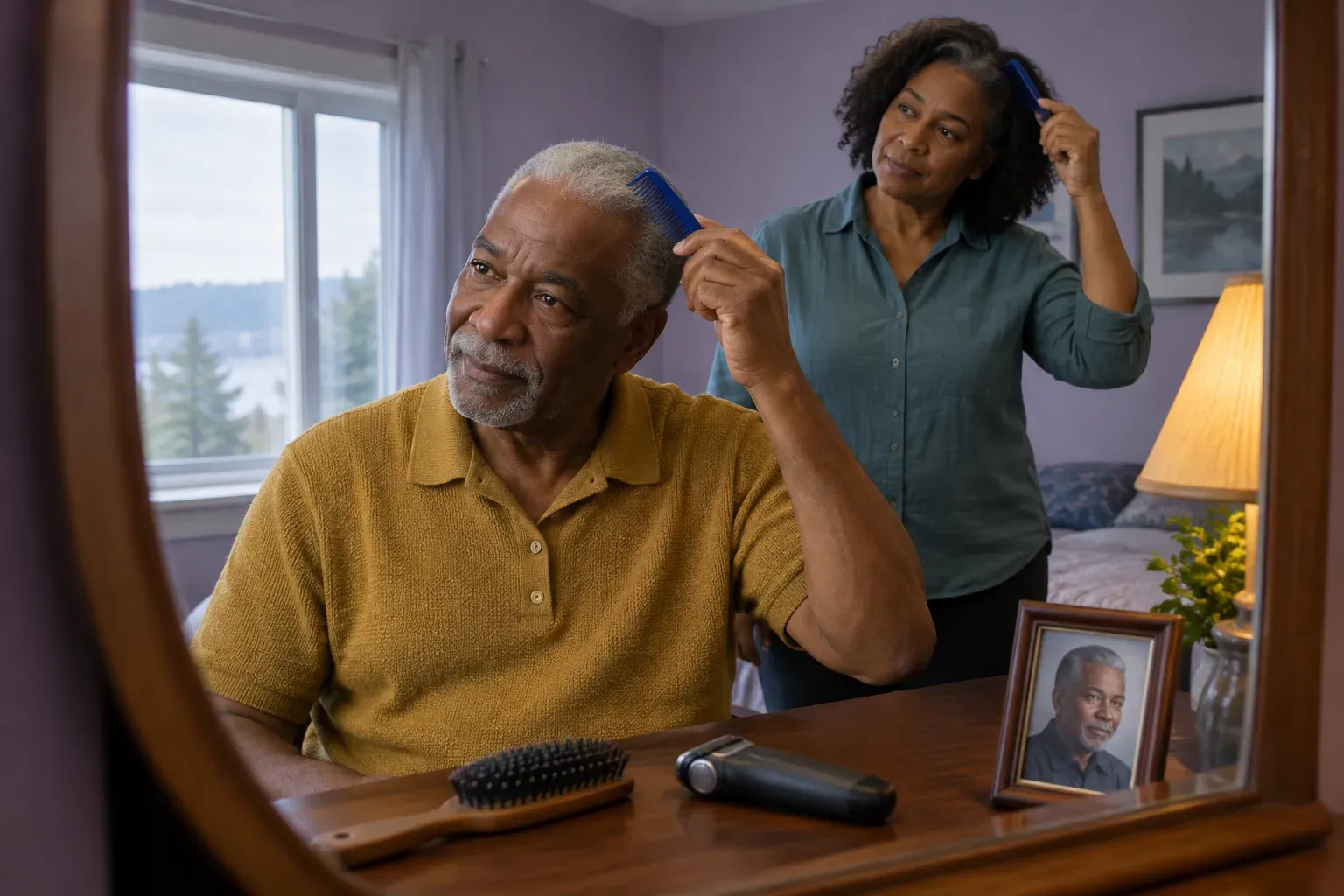
The Alzheimer’s Association supports keeping favorite toiletries and demonstrating grooming alongside the person. Instead of taking over the brush, a helper might demonstrate combing their own hair and invite the person to copy. Simpler tools, such as an electric shaver, may also be worth discussing rather than introducing several unfamiliar items at once.
Keep the handoff specific. “Offer the blue-handled brush after breakfast; let them begin” tells a helper more than “needs grooming assistance.”
Agree on daily tasks—not a promise of salon services
Ask a home-care agency to describe what assistance would look like for each task. Setting out a toothbrush, giving a reminder, demonstrating the movement, and providing hands-on help are different arrangements.
Possible discussion points include routine combing, face washing, toothbrushing, and electric shaving. Have the agency confirm each task against your family member’s needs, the caregiver’s skills, and agency policy. Don’t assume that agreement to one grooming task covers all the others.
Keep haircuts, coloring, and professional styling with a qualified hair-service professional. A caregiver’s role in personal care doesn’t, by itself, establish qualifications to perform those services. Likewise, ask a separate professional about needs outside ordinary nonmedical grooming rather than adding them informally to a caregiver’s duties.
For appointment support, clarify the whole sequence: preparing to leave, the ride, waiting, staying during the service, and returning home. Establish who communicates hairstyle preferences and who contacts the family if the visit ends early. Those details should be agreed upon before the appointment day.
If the salon becomes distressing, reconsider the location
A once-familiar salon may stop feeling manageable. The Alzheimer’s Association suggests exploring a visiting barber or stylist when salon visits become distressing.
Start by asking the familiar professional whether they offer home appointments. Don’t assume Tootsie’s Parlor—or any other named provider—does. If you contact someone new, ask whether they serve the home address and have the relevant professional credentials and authorization for in-home services.
Also discuss charges, equipment, chair and lighting needs, cleanup, companion presence, and how the visit can be stopped. A simple haircut at home may call for a different setup than the family expects; settle that before booking.
Changing the haircut location doesn’t require changing everything else. Keep the usual daily brush, toiletries, and sequence where they still work. The goal is continuity, not a complete reinvention of the morning routine.
Put privacy, permission, and pausing in writing
A grooming plan should describe not only what gets done, but how help is offered. Explain the next step and seek the person’s willingness before hands-on assistance. Include privacy preferences and a clear response to “no,” pulling away, or other signs that help is unwelcome.
A practical instruction might read: “Offer the brush and ask before helping. If they decline or pull away, pause. Record what wasn’t completed and follow the agreed communication plan.”
Avoid making completion the measure of a successful visit. Washington’s home-care client rights include refusing specific services and receiving respectful, private care. A written agency plan should identify the actual services and their frequency. Your family’s grooming notes can add useful preferences without replacing that plan.
If the routine repeatedly doesn’t work, ask the agency to review the approach rather than simply repeating it. Specify who should receive an update and what information they need.
Match recurring support to the whole routine
If the only unmet need is a haircut, start with a barber or stylist. If daily grooming or appointment accompaniment is part of a broader recurring need, you can explore Veya’s non-medical dementia home care and discuss the routine you want to preserve.
Veya serves King and Snohomish counties, Washington, not the entire state. Review current pricing and weekly scheduling requirements before deciding whether the service fits; don’t assume it’s an occasional appointment-only arrangement. Start dates depend on finding an appropriate caregiver whose skills and availability fit the requested schedule.
Bring the one-page handoff to that conversation. The most useful starting point is concrete: what your family member still does, where help is missing, and how to offer that help without taking over.
Care starts at $45 per hour with a 20-hour weekly minimum. Your rate and service terms are confirmed before care begins.
This guide is general information about non-medical support at home. For diagnosis, treatment, medication, or other medical decisions, speak with a qualified healthcare professional.
Sources
- Alzheimer’s Association — Dressing and Grooming
- Washington Administrative Code 246-335-410 — Definitions—Home care
- Washington Administrative Code 246-335-435 — Bill of rights
- Washington Administrative Code 246-335-440 — Home care plan of care
- Washington Department of Licensing — Get your license: Salon Shop, Personal Service, Mobile Unit