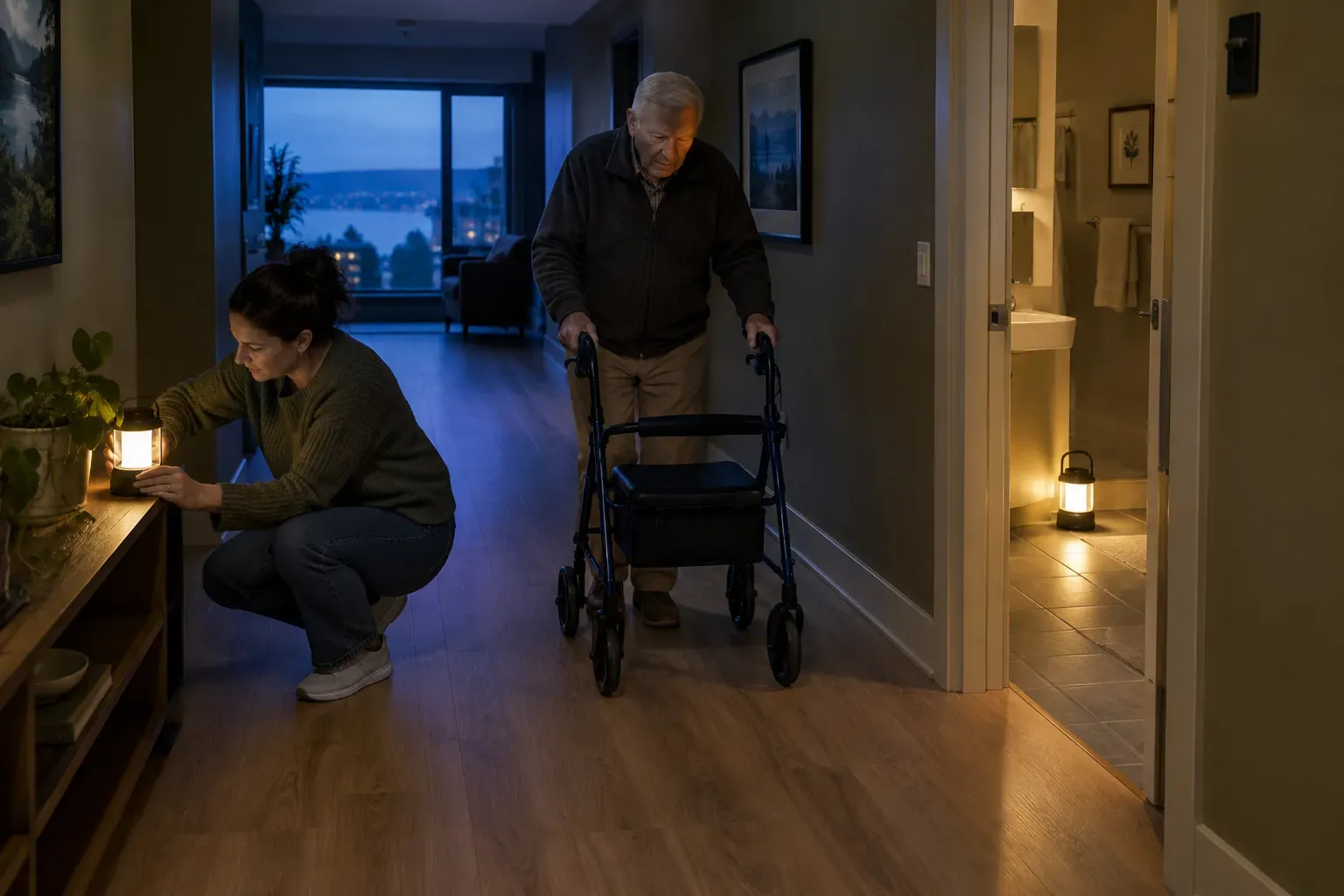
The lights go out, your parent’s phone still works, and someone says, “The caregiver is coming tonight.” That sounds reassuring—until you remember the elevator, the electric stove, or the garage door between your parent and a ride.
Caregiver presence alone isn’t the deciding factor. Plan to stay home only while safe access, lighting, meals, warmth, communication, and necessary assistance remain workable. Confirm the support and a backup destination before you need either.
For Bellevue families, this means checking both the home and the arrangements around it. King County advises considering a shelter or a friend’s home with heat and power during an extended outage. The framework below can help your family make that decision; it isn’t an official safety assessment.
Start with the way out
Before counting flashlights, ask whether your parent could leave the building without electricity.
For an apartment or condominium, ask the property manager exactly what backup power serves: elevators, corridor lighting, entrance doors, and garage gates. Ask how long that backup is expected to operate and what happens when it stops. These are building-specific questions, not assumptions about Bellevue properties.
Include any powered equipment your parent ordinarily needs for transfers. A caregiver’s presence doesn’t make that equipment—or a staircase—usable. Don’t build a plan around someone carrying your parent downstairs.
If leaving safely depends on an elevator and backup operation is unconfirmed, arrange an earlier move while access remains available. Waiting until the apartment becomes uncomfortable may leave fewer options.
PSE recommends practicing an evacuation plan and learning how to operate electric doors manually. Check the actual route from your parent’s usual chair or bed to the vehicle, including locked entrances and garage access.
Rehearse one evening without power
Walk through dinner, a bathroom visit, and bedtime with your parent. Ordinary routines reveal gaps that a box of emergency supplies can hide.
Place battery-operated lighting along the route between the bed, bathroom, and exit. King County recommends battery lights rather than candles. Check that your parent can find and operate them, and that lighting doesn’t depend on carrying a flashlight while using a mobility aid.
Choose ready-to-eat meals your parent can manage with their usual eating assistance. A stocked cupboard won’t help if every meal needs heating or packaging your parent can’t open. Confirm drinking water and a workable toileting routine, including the help and supplies normally required. Keep refrigerator and freezer doors closed as much as possible, as King County advises.
Washington’s Be 2 Weeks Ready goal encourages households to prepare supplies for a substantial disruption. It does not mean your parent should remain in an unsuitable home for two weeks. Supplies support a plan; they don’t replace accessible rooms, working assistance, or a safe exit.
Treat warmth as its own decision
Don’t assume gas service means working heat. Confirm which heating appliances actually operate without electricity. PSE includes this check in its public-safety-power-shutoff preparation guidance; other outages may happen without advance notice.
Write down who will check the indoor temperature and when. Agree beforehand on a household-specific point for relocating rather than trying to settle it during a cold, dark evening. There isn’t one temperature or outage duration in this planning framework that makes staying appropriate for every household.
Never use an oven or gas range to heat the home, or bring a barbecue or propane heater indoors.
Warm blankets may help with comfort, but they don’t resolve a failing heating plan. If your agreed warmth condition can no longer be maintained, act on the relocation plan rather than waiting for another restoration update.
Give communication—and caregiver coverage—an owner
Choose one family coordinator and a backup. Set check-in times, charge power banks, and leave a written contact sheet where your parent and caregiver can find it. PSE recommends an out-of-town contact and texting when calls can’t get through. Decide who will check in person if remote communication fails.
King County directs residents outside Seattle to PSE for outage reporting. PSE allows reporting without an account and offers outage notifications. Assign someone to report the outage, enable alerts, and monitor updates. Restoration times are estimates, not guarantees; they shouldn’t override an agreed reason to leave.
Then confirm the human coverage. Ask:
- Who can actually cover each essential visit?
- How will the caregiver enter if powered access fails?
- What happens if travel is unsafe or a shift can’t be filled?
- Who takes over, and how will the family know help hasn’t arrived?
Veya’s start dates depend on finding an appropriate caregiver whose skills and availability fit the requested schedule. Don’t assume emergency availability or uninterrupted coverage.
Non-medical home-care support can include companionship, meal preparation, personal-care assistance, and suitable transportation. Ambulation and transfer support depends on caregiver training, your parent’s needs, and equipment. None of these services restores electricity, heat, or an elevator, and they shouldn’t be treated as emergency evacuation arrangements.
Decide what means “we’re leaving”
A useful plan replaces “we’ll see how things go” with observable conditions. Discuss proposed decision rules with your parent or spouse before an outage. Reasons to relocate could include:
- Loss of a safe exit or usable bathroom access.
- Lighting that remains inadequate after using available battery lights.
- Inability to maintain the household’s agreed warmth condition or provide usable meals.
- Failed communication without a confirmed in-person backup.
- A missed essential caregiver shift with no replacement.
For every trigger, name who makes the decision, who drives, and where your parent will go. Choose a backup destination, too.
Check the destination as carefully as the home: power, entry access, sleeping arrangements, bathroom access, and any necessary assistance. A relative’s warm house may still have an unusable staircase. Confirm whether caregiver support can continue there rather than assuming an existing schedule transfers automatically.
Don’t count on a Bellevue community center being open, accessible for your parent’s needs, or available overnight. If considering a public shelter, verify its current availability and suitability before departure.
Put the Bellevue plan on one page
Keep a paper copy with your parent and share it with everyone assigned a role. Include:
- Building: property-manager contact, backup-power details, and exit arrangements.
- Outage updates: PSE reporting details, notification setup, and the person monitoring them.
- People: family coordinator, backup contact, confirmed caregiver schedule, and replacement plan.
- Stay-home checks: lighting, meals, water, toileting, warmth, communication, and check-in times.
- Relocation: triggers, decision-maker, destination and backup, driver, keys, and essential supplies.
Include road safety in the departure plan. King County says non-working traffic signals should be treated as four-way stops. Avoid downed lines and damaged trees; don’t assume the usual route remains usable.
For advance preparedness questions, Bellevue Emergency Management lists 425-452-6807, a non-emergency number staffed during normal business hours. It isn’t emergency dispatch or a guaranteed relocation service. Call 911 for emergencies.
If you’re considering caregiver help as part of this plan, talk with Veya about your family’s non-medical support needs. Bring the daily routines, requested schedule, entry arrangements, and backup plan. The useful question isn’t simply whether someone can be there—it’s whether the whole plan still works when the power doesn’t.
This guide is general information about non-medical support at home. For diagnosis, treatment, medication, or other medical decisions, speak with a qualified healthcare professional.
Looking for support nearby? Explore caregiver placement in Bellevue.