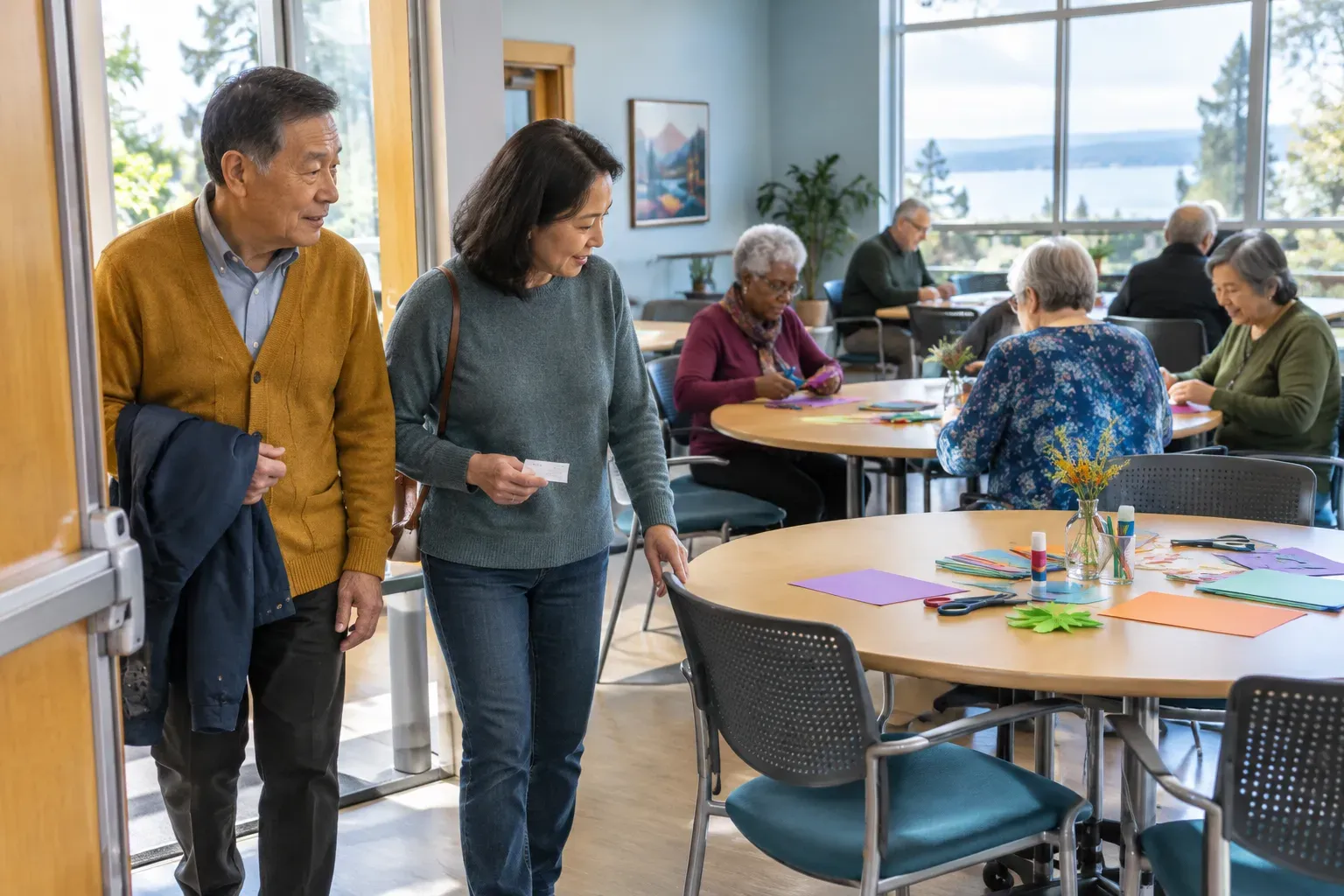
Your parent wants to try an activity at North Bellevue Community Center. You can arrange a ride there and back. But one question remains: who helps between the car door and the activity room—and during the hours before pickup?
For adult children and spouses planning an outing in Bellevue, Washington, that’s the distinction that matters. Transportation alone can work when your parent can manage the time between drop-off and pickup independently, or when specific assistance has been explicitly arranged. If an essential step has no clearly responsible helper, plan for accompaniment rather than assuming someone will step in.
Walk through the whole outing, not just the drive
Start with what your parent wants to do, then picture the day from getting dressed to settling back home. Ask your parent which parts feel straightforward and where they’d welcome help.
A useful walkthrough covers:
- Before departure: Getting dressed, using the restroom, gathering belongings and leaving home on time.
- At the vehicle: Getting in and out, managing a mobility aid and carrying a bag or coat.
- Inside the center: Entering the building, checking in, finding the room and choosing a seat.
- During the activity: Using the restroom, keeping track of belongings, joining conversations and asking for help.
- Coming home: Finding the pickup point, handling a changed departure time, unlocking the house and getting comfortably settled.
Someone might enjoy a group activity independently once seated but need help reaching the room. Another person may move around comfortably yet want a familiar companion to help them join in. Those are different needs, and they call for different arrangements.
Confirm the activity before arranging caregiver hours
North Bellevue Community Center is at 4063 148th Ave NE, Bellevue. Contact the center at 425-452-7681 or NBCC@bellevuewa.gov to ask which current activities fit your parent’s interests.
The city lists community lunch and Monday Mixer among the options. Before booking support, confirm the activity’s date, room, duration, registration requirement, available space and cancellation arrangements. If you’re combining lunch with another program, check each separately rather than treating the afternoon as one reservation.
There’s a practical scheduling wrinkle: the center’s published pages disagree about Monday Mixer’s start time. One lists 1:30 p.m.; the Programs page lists 1 p.m. Both show a 2:45 p.m. finish. Neither listing should be treated as definitive for your planned visit. Check the city’s registration catalog and confirm the actual session with the front desk before arranging pickup or caregiver hours.
Registration reserves participation under the program’s rules; don’t assume it includes individual assistance.
Choose among three arrangements
The right choice depends on who will handle each part of the visit—not simply who owns the vehicle.
Transportation only. This can suit someone who can independently enter, find the activity, manage the visit and reach the agreed pickup point. Confirm what the driver actually provides; don’t assume an escort or help with belongings is included.
An escort to a defined handoff point. A driver or companion might walk your parent to check-in or the activity room and return later. This works only if your parent can manage afterward, or a specific person has agreed to provide the needed assistance. “The front desk” isn’t a complete handoff plan unless the center has confirmed the arrangement.
A caregiver who stays throughout. Continuous accompaniment may fit when your parent needs personal assistance, help moving between spaces, companionship or support with an unexpected early departure. Agree on whether the caregiver participates alongside your parent or remains nearby.
For all three, name who handles check-in, restroom needs, belongings and pickup changes. These are arrangements to negotiate, not automatic responsibilities of drivers or center staff.
Ask whether a caregiver can attend this particular program
Before reserving care, ask the center:
- May a paid caregiver attend this activity and remain alongside the participant?
- Does the caregiver need separate registration, a seat, a meal reservation or an admission payment?
- What assistance can staff provide, and what must the companion handle?
- If your parent needs to leave early, how should the companion notify staff?
A January–April 2025 city brochure welcomed caregivers to Older Adult Social Hour. That historical statement doesn’t establish current rules for Monday Mixer or other activities. Confirm the policy for the actual session you’re booking.
Then work through arrival. Ask which entrance and drop-off location to use, how far the room is from that entrance, what accessible route and restroom arrangements are available, and where an accompanying caregiver can park. Don’t build a plan around free parking, a particular accessible entrance or staff meeting the vehicle without confirmation.
A center excursion is different from a ride to the center
North Bellevue Community Center advertises organized trips with round-trip transportation departing from the center. It also describes limited, optional home pickup for Bellevue residents upon request.
That excursion arrangement does not establish a general home-to-center shuttle for ordinary activities.
If your parent chooses an organized trip, ask separately whether home pickup is available for that departure, what boarding assistance is offered, whether a caregiver must register and whether the caregiver can travel with your parent. Also establish who provides assistance throughout the excursion and how an early departure would be handled. Don’t assume the same plan works for both an activity at the center and a trip away from it.
Ask the care provider to scope—and price—the full visit
Give the provider the whole sequence: preparation at home, vehicle entry and exit, building escort, activity attendance, personal assistance, companionship, return transportation and help settling in afterward.
If walking or transfer assistance is needed, confirm that the proposed support matches the caregiver’s training, your parent’s needs and the equipment involved. Be specific about restroom assistance rather than leaving it under a broad request to “help as needed.”
Veya’s non-medical services include companionship, personal-care assistance and caregiver-driven transportation without client mileage charges. Its Bellevue home-care information can help frame a discussion about support beyond the ride. Veya is not affiliated with North Bellevue Community Center; participation rules must be confirmed with the center.
For budgeting, ask when billing begins and ends and whether activity attendance, waiting, delayed pickup and return-home assistance count as paid time. Ask whether a split visit is available, how it would be billed and how parking, admission, meals and cancellations are handled. Don’t assume waiting is free or that every outing expense is included.
Veya has a weekly minimum, so don’t assume a short outing can be booked as a standalone visit. Review current Washington home-care pricing and request a written scope showing how the outing fits the proposed schedule.
Let the first visit answer the remaining questions
If possible, accompany your parent on an initial visit. Notice where help is actually needed: leaving home, finding the room, getting comfortable with the group or locating pickup afterward. Ask what your parent would prefer next time.
Then choose the least extensive arrangement that leaves no essential task unassigned. Obtain written confirmation of the activity details, caregiver participation, transportation responsibilities, handoffs and billable hours. Include a contact plan for delays or an early departure.
You can discuss the full outing with Veya before committing to a schedule. Start dates depend on finding an appropriate caregiver whose skills and availability fit the requested support. The goal is a workable plan for the whole visit—not simply a ride that gets your parent to the door.
Care starts at $45 per hour with a 20-hour weekly minimum. Your rate and service terms are confirmed before care begins.
This guide is general information about non-medical support at home. For diagnosis, treatment, medication, or other medical decisions, speak with a qualified healthcare professional.
Looking for support nearby? Explore caregiver placement in Bellevue.